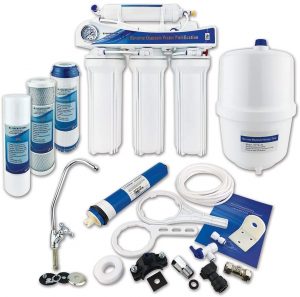
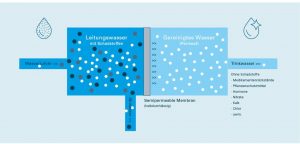
A reverse osmosis system purifies water by passing it through several filtration stages, removing impurities up to a certain level (up to 99%). These filtration stages include pre-filters, membranes, and, if necessary, post-filters. The number and composition of the filter stages vary from system to system. Most reverse osmosis water filters They have several pre-filters, a reverse osmosis membrane, and a post-filter. The pre-filters remove coarse impurities from the water, while the membrane, which is the heart of a reverse osmosis system, does the main work. A post-filter ensures that the reverse osmosis water is particularly refreshing and tastes even better.
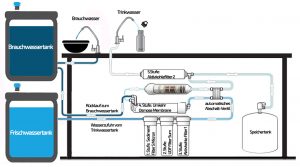
The disadvantage is that water is "used" to force water through the membrane. The ratio is usually 1:5, meaning that to produce one liter of drinking water, five liters are passed through the membrane. To cope with this high water consumption, it makes sense to have an additional tank, which can be designated as a greywater tank. This water can then be used for washing or rinsing, for example.
Here's a diagram of the setup of a reverse osmosis system. The shut-off valve is a safety valve that switches off the pressure pump if a leak occurs.