

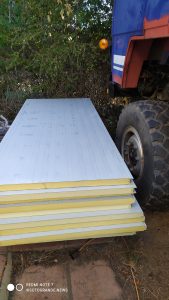
 Finally, two months after ordering, the sandwich panels have arrived. This time I decided to use 50 mm for the roof and floor, and only 30 mm for the side walls.
The sandwich panels are standard tongue-and-groove facade panels with a 0.6 mm thin sheet metal facing, galvanized and painted, and corrugated. They weigh 10.6 kg for the 30 mm panel and 11.4 kg for the 50 mm panel. I will reinforce the 30 mm side walls with 20 mm XPS foam and 11 mm tongue-and-groove boards, resulting in a total thickness of 61 mm.
The reason I do it this way is that with my last cabins made from 60 mm panels, I couldn't hide the cables and water installations anywhere.
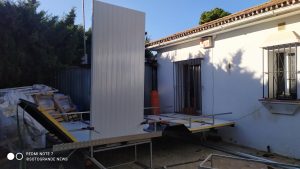 Because I am now building a timber frame, I have the opportunity to embed cables, water pipes, switches, plugs and so on into the walls.
Ultimately, I opted for the facade sandwich panels for cost reasons. I only paid €1910 for the panels for a cabin measuring 4.6 m (L) x 2.4 m (H) x 2.47 m (W) (as of September 2021). Many people, however, believe it's a disadvantage that the walls aren't made from a single piece. I actually see it more as an advantage. 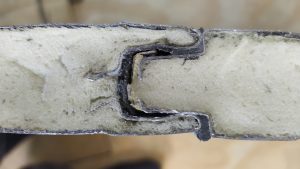 Because the panels are joined together with tongue and groove and glued, I have three times the material there, which acts like a reinforcement or a stringer:
However, the panels also have a significant drawback. They are quite susceptible to impacts. 0.6 mm sheet metal isn't very thick, and the polyurethane foam offers little protection. If it bothers me at some point, I'll glue strips of aluminum checker plate or Dibond to the exposed areas.